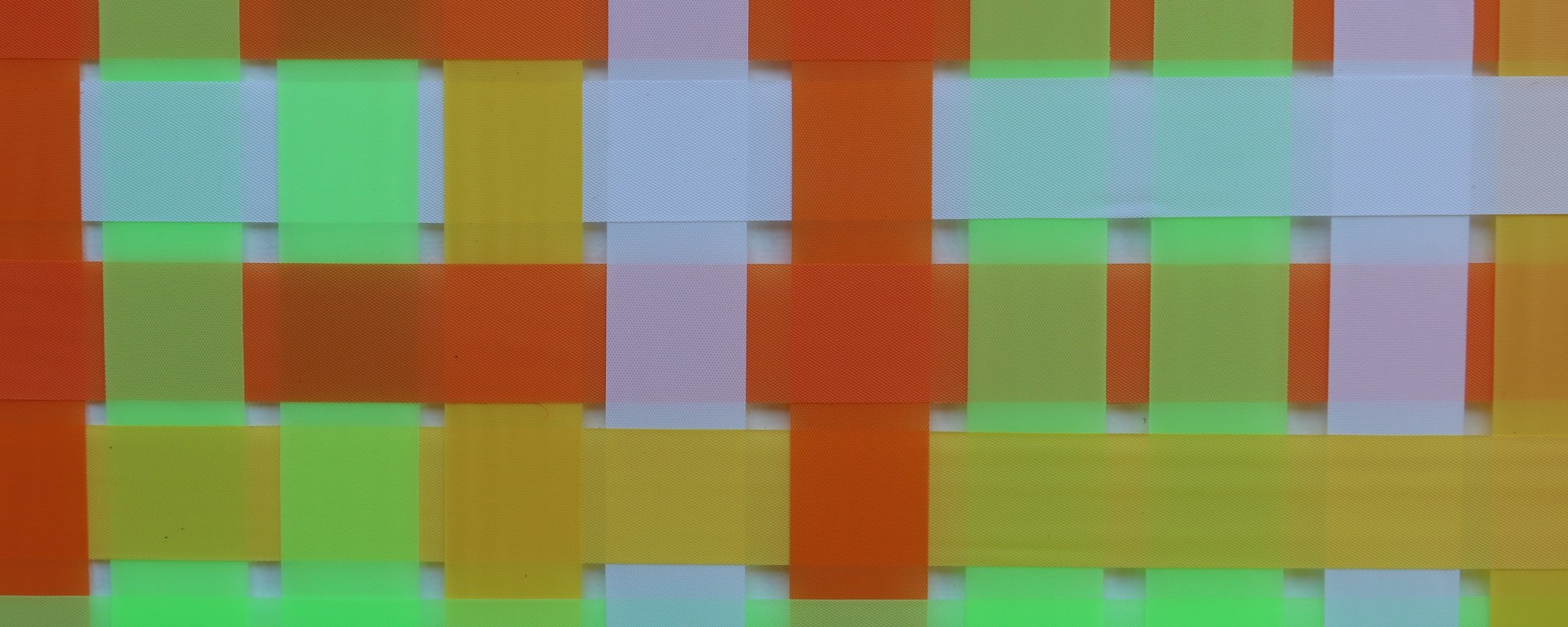
Tape.
A noun, a verb.
Things held together, recorded, kept safe.
Problems solved.
Well…at least until the glues break down and technologies fade.
Temporary security.
The history of Tape Art dates back to the urban art of the 1960-80s, when its easy use and removal made it perfect for quick urban interventions in public spaces. Mostly collaborative and created at night, these installations would appear across surfaces and locations throughout the city – courtyards, footpaths and abandoned buildings – before disappearing without a trace. A temporal alternative to spray painted graffiti, it spoke of transience, reclamation, risk and repair. Over time tape has evolved as a fine art medium, elevated from a humble, everyday material by contemporary artists whose practices blur the boundaries between high and low culture.

Variations on Tape brings together nine artists whose practices continue this legacy – abandoning the material’s original purpose, but not its meanings and associations. Like tape itself, the works are tactile and tangible, spatial and substantial, yielding and immediate. A political charge runs through the exhibition – from Deborah Eddy’s high-vis corset that uses flagging tape to question the undergarment’s use as a device to constrict women, to Diana Vallejo J.’s hidden messages that only reveal themselves to the properly positioned viewer, to Edwina McLennan’s The Edifice 2021, which is the physical manifestation of her contemplations on language and how it can include or exclude people in society through barriers, both real and imagined. In the weaves and soft drapings throughout the exhibition, there’s a nod to the history of women artists whose practices and technical skills in weaving and stitching were devalued as ‘domestic’ or ‘feminine’, while Justene Williams’ largescale Volcano tree painting 2015-21 takes its inspiration from Shinto mythology and the connection between humans, kami (gods) and the environment.
We might look back on the last 18 months as an era of ‘peak tape’ – think arrows on floors demarking where to enter, where to exit, how to keep 1.5mt apart; signs of gratitude and protest secured to balconies and lengths of dowel; QR codes stuck crookedly to windows; the small strip of white that holds the cotton wool to your skin after vaccination. An object first invented as a quick fix for soldiers’ wounds in 1845 now repairs our mementos, secures substrates, directs us to safety, and still sometimes saves lives. In its intrinsic problem-solving nature and flexibility, it mirrors the constantly morphic practice of art making. Any wonder artists were drawn to its properties.
Artists: Deborah Eddy, Erica Herbert, Natalie Houston, Renee Kire, Edwina McLennan, Sarah Poulgrain, Gin Sen, Diana Vallejo, Justene Williams. Curator: Virginie Senbel-Lynch.
Commissioned for the exhibition Variations on Tape at QCA Galleries, Brisbane, 2021
 CULTURAL FLANERIE