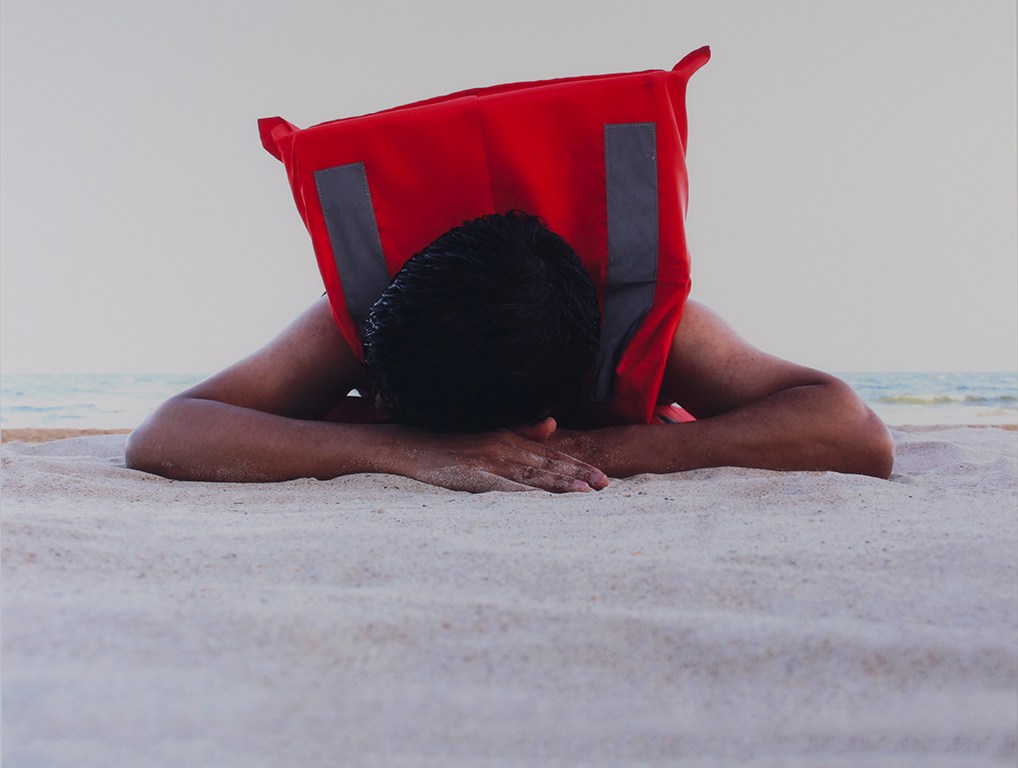
Carrie McCarthy (CM): Let’s start with the 25th anniversary of your arrival in Australia, which you’ve recently marked. Is that a happy or bittersweet moment?
Sha Sarwari (SS): It’s kind of strange. When I moved to Melbourne, I became more aware of the years passing because the change of seasons was more obvious. As the weather was changing, I began thinking ‘we’ve been here one year, now two years…’ Suddenly it’s 20, 21, 25 years that I’ve been in Australia.
I think to a degree I resisted seeing Australia as home, you know? I still think of Afghanistan as home. I look at the news from Afghanistan every day on the BBC or Al Jazeera websites. My wife says ‘why do you look at these all the time?’, and I think, well, that’s my home. One day we might have to go back!
CM: You came to Australia as a refugee. How was the decision made for you to leave Afghanistan?
SS: It was my parents’ decision – I didn’t want to leave, I said I wanted to stay, but they kind of tricked me and said ‘you go first, we will come after you.’ That never happened, my parents passed away. But I have a sister here now. And I’ve got my mother-in-law, sister-in-law and cousins that have come through the same process.
CM: Did you resent your parents for making you do that?
SS: At first this idea of seeking protection made me feel that I’m a coward. They sent me away to protect me, but I thought that I should have been there protecting my land. I thought that even if I was killed I would have a more honourable life than coming here. I feel guilty sometimes that I left. But hopefully I’m remedying it another way through art, and through being a father myself.
For a while when I was in detention, life was miserable. The hard part for people to understand is what refugees are expecting when they come here – the free world that’s portrayed to them, compared to the world they end up living in. There’s an idiom in Farsi, awaze dhol az door khooba, which translates to something like ‘the sound of the drum sounds very nice from afar’. There are the human rights violations, putting refugees in detention, but there’s also the politics, which keeps you trapped in the middle of competing ideologies and social opinions.

CM: How did you create a new life for yourself in Australia after the experience of detention?
SS: When you’re released, you feel overwhelmed. It was like coming out of prison. What am I going to do? Where do I find job? How do I eat, how do I adapt to a new life? There are a lot of difficulties coming to a new culture and starting from nothing. But then you study the nuances of the new society, and try to find a way. It took me about 2-3 years to overcome that feeling. Then I started to think of it as an adventure. Wherever I am, that’s my home. So I’ve stopped longing too much for Afghanistan, although I’d love to go back one day.
The friendships I have made are so important. They gave me protection, they guided and influenced me, no matter what political discussions about refugees were happening. If I didn’t have the generosity of these people, I wouldn’t be in this position. I’d be working in a factory, or in the field collecting mangoes or tomatoes. Which is not a bad life, but I might never have realised my artistic talent. And I was lucky. I met my wife and she’s very supportive.
CM: Did you study art in Afghanistan?
SS: No! We were trained in writing in Farsi script, but no visual art. I had no plan for what wanted to do as an adult. The political uncertainty in Afghanistan made it hard to have a plan and follow it. But I had a flatmate in Australia, also a Hazara refugee, who was a self-taught artist. To see him come from nowhere and establish himself was very inspiring. I also came across another Hazara who had come here to study design. I told him I’d always wanted to do that too, so he helped me make a portfolio and I got accepted.
Funny story – when I started my graphic design course my Australian friends said “yeah, good, that’s a great career!” But when I started my Visual Art degree they said “what you going to do with that?” And I was like, “what do you mean, I’m gonna be famous!” I was so pumped up! Then I finished my degree and started to look for opportunities, I realised maybe I should have done something different!
CM: Ha! The ongoing dilemma of the visual artist! Back then, was there already an activist element to your artwork?
SS: That happened when I started at art school. I learned that I could use my artworks to get my experience as a refugee to the public arena. I think when you have the chance to express yourself publicly, you should. Art school was challenging though. For my first presentation, the assessor didn’t like my work, but she didn’t really understand the message behind it either. We spoke afterwards, and I realised I wasn’t getting the message across properly. She taught me that if I wanted to make real art, I had to expand my skills and keep striving to find the best and most original way to tell that story.
I began as a painter because that’s what my flatmate was, but the works I produced weren’t good enough. I tried to argue that passion should count for more than grades, but it didn’t help. So I experimented with other fields like printmaking and photography. My tutor said ‘you know, painting is viewed as heaven, and everything else is seen as hell. Welcome to hell!’ He was a funny guy.
CM: Do you sometimes feel constricted by the weight of the stories you’re hoping to tell?
SS: No. The topics are heavy, but I’ve come to realise it’s something I should continue to maintain a dialogue with. I want my art to be a counter to the way the media portrays refugees. The inclusion of artists that are in the margins is really important. Otherwise, we get left out of conversations, and our stories aren’t seen and heard. Art should be a place where difficult conversations can happen.
CM: You’ve previously spoken about your frustration at always being identified first as a refugee or ‘foreign’ artist. Can you talk a little about that?
SS: I get frustrated with only being curated into shows about refugees, or immigration, or Islamic art. It limits the possibilities for connections and common understanding. I want to contribute to Australian culture and to working towards true multiculturalism. Otherwise I can’t grow as an artist. I make work about lots of things now, not just being an Afghani refugee. After 20+ years in Australia I now have new memories, and other stories to tell. My focus now is how to weave my story into the culture I’m living in and establish belonging.

CM: Thinking back to your early exhibitions, like Silent Conversation at Jugglers Art Space in 2015, which featured a hammock made of barbed wire and a boat made of newspapers, as well as the photographic work National Icon (2014) which subverted what’s probably Australia’s most famous photograph, Max Dupain’s Sunbaker (1937). Those early works were obvious in the messages they conveyed, but your recent work seems to be much more subtle. How do you see your practice evolving?
SS: There’s a shift in making and thinking about the work. It’s more strategic now, less emotionally responsive. It’s more aesthetically pleasing, because I want audiences to experience the visual first and allow for other interpretations. I can bring a richness to the work this way. Then when they read about the artwork and its inspiration the message hits them unexpectedly.
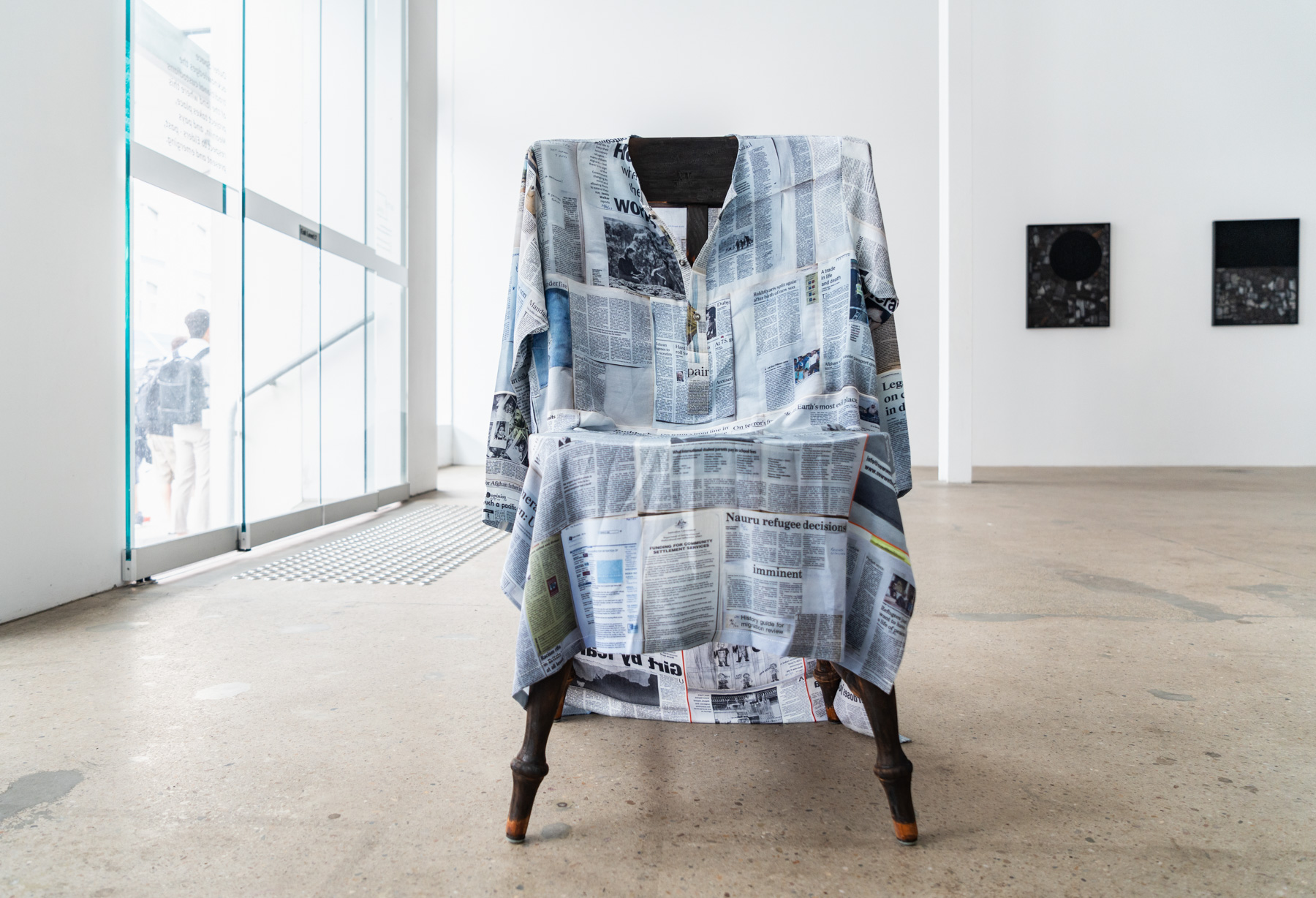
There are so many layers in my work that I want to explore in the in the future, maybe through writing. I’m more interested in collaborating with my fellow artists and taking time to think about the message I want to convey. My approach now is to look for gentler ways of saying things through art. Like a moth to a flame (2020), which is a robe made from silk printed with newspaper articles, is a good example. It appears soft and flowing but features all the harsh media reports about refugees. I wanted to take that narrative and subvert it and make something beautiful out of it.
CM: Was Like a moth to a flame the precursor to your new works about the absence of language and culture?
SS: Yes. They speak to the politics of language, how language is used to portray us and create negative or positive imagery. Most of the time the people in power control the language, and language determines power structures and class systems. For example, you can’t get a decent job in Australia if you don’t speak very good English.
CM: How do you choose which elements of language to include?
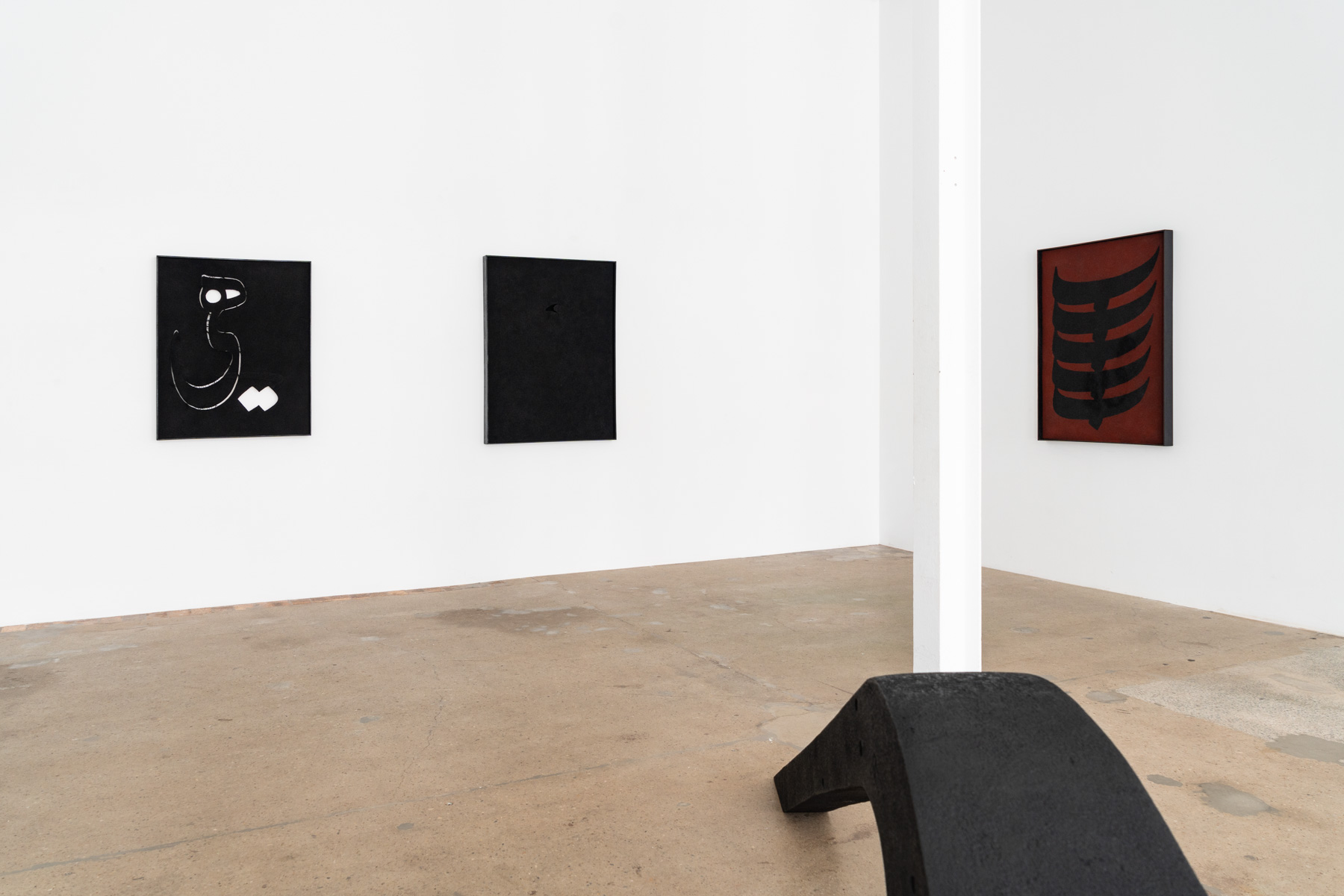
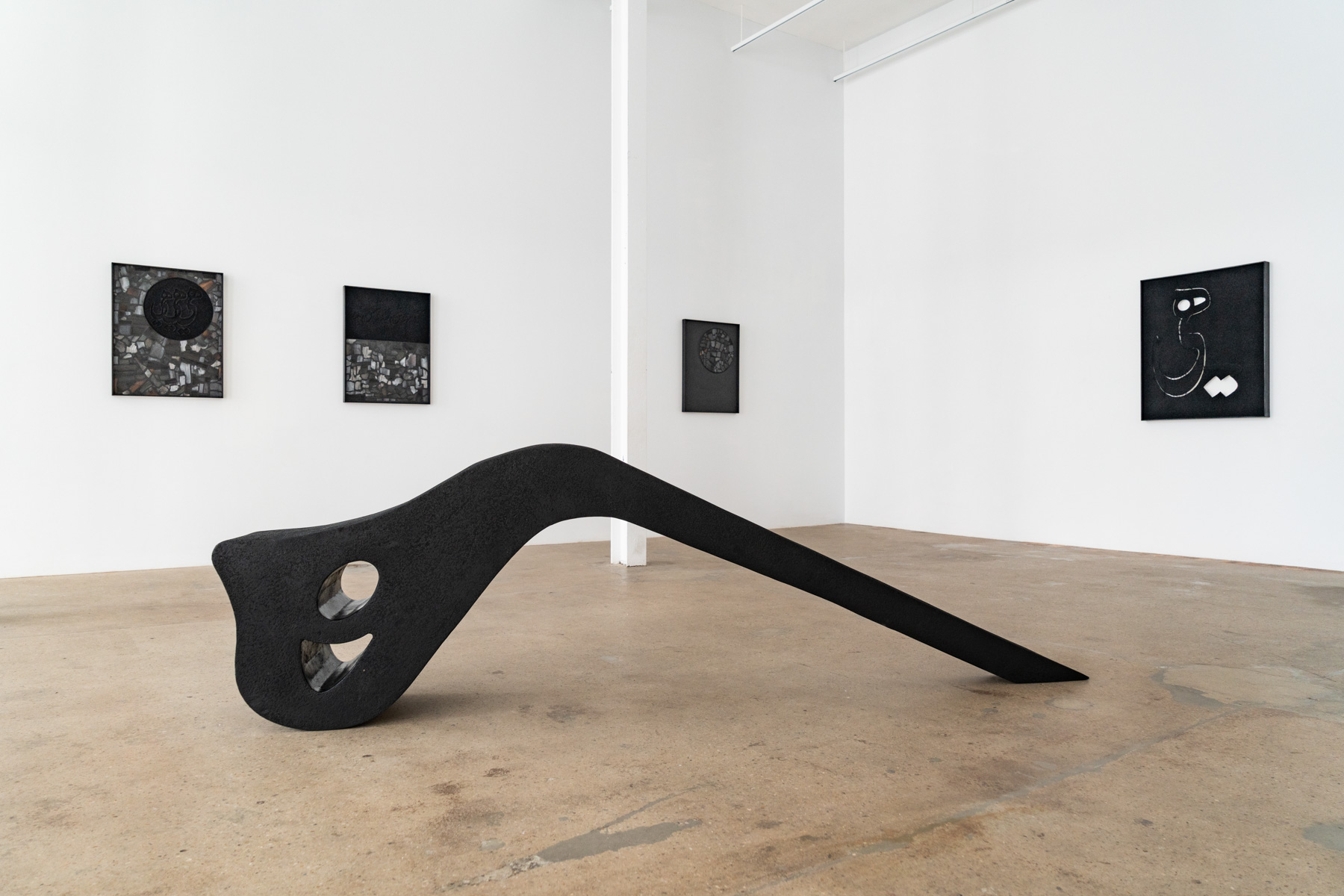
SS: I get stuck on the visual aesthetic of letters. I’m particularly drawn to the Nastaleeq style of writing Farsi script, which has a very opulent style. Some letters are very figurative; they look like a lion’s roar, with a tongue coming inwards. Surprisingly when I researched the artist who designed this script, I learned he got his ideas from the natural world, and the curves of animals and plants.
The letter works are about a person coming to a new culture and not understanding. When I’m asked what the works mean, I’m reversing that process by giving audiences a sense of what it’s like to not know and not understand. And I’m putting an element of my culture into the broader culture. It might not be understood, but aesthetically its there.
CM: Can you explain the differences between the application of the imprinting and embossing techniques you use? And the use of charcoal in your work?
SS: When I imprint designs, they’re signifying a place I used to live in and where things were growing around me. Embossed letters signify things that are growing on me, like my life in Australia, which I resisted for a while, but it grew on me anyway. The charcoal works are a metaphor for nothingness, and the way that my experience of nothingness became the basis for everything. I had no language, no connections, but I slowly built up from that. It’s about rebirth, and the phoenix rising from the ashes.
CM: How do you see your practice developing?
SS: When I reflect on the materiality of my current work, it resonates with my own story. The timber I use was once a seed that grew. It gets cut down and burnt to the point it becomes almost nothing. I was born in a place and uprooted, but this new place made me richer and everyone I come across feeds my imagination. These memories and experiences are the things that makes you whole. If you let them go you’ll become empty, so you’ve got to use them. Hopefully through my intervention, another seed can grow and stretch imaginations.
Liminal برزخ
Redland Art Gallery
16 June to 30 July 2024
See more of Sha Sarwari’s work via his website.
 CULTURAL FLANERIE